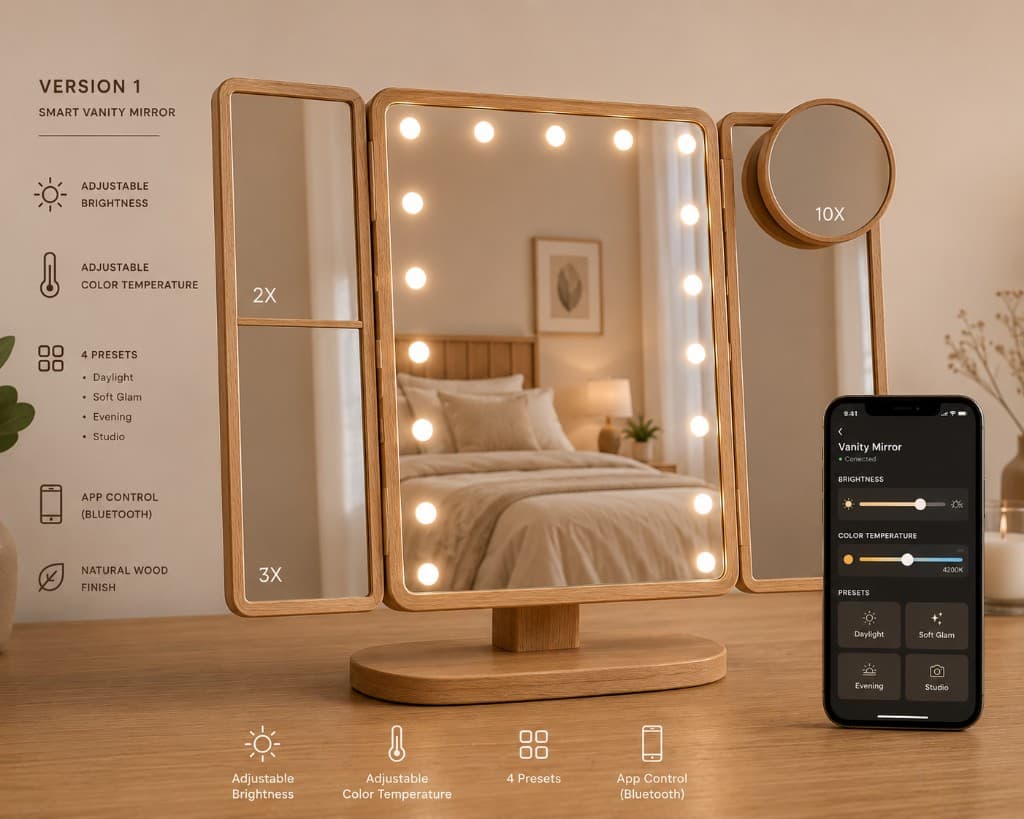
What we learned talking to VCs—from YC rejection to building a real company
One month after launching our prototype, Glamir had 40,000 downloads and more than $8,000 in first-month revenue—and we still did not get into Y Combinator. Here is what that feedback taught us, and what a year of investor conversations changed.
Fundraising stories on the internet tend to end with a term sheet. Ours starts with a polite no—and we think that is worth sharing, because the no was often correct.
In late 2024, about one month after we launched our Glamir prototype, we had roughly 40,000 downloads and more than $8,000 in revenue in the first month. We earned a Y Combinator interview. We did not get in. At the time, that stung. In hindsight, the feedback was fair: we had built a compelling beauty tool with three AI features, not yet a durable company.
One month in: traction without a moat
The early app did what we set out to prove. People wanted personalized makeup guidance on their phones—analysis, occasion-based looks, and a recreate-a-look tool that matched reference photos to shades and techniques. Downloads moved quickly. Revenue showed up faster than we expected for a first release. That momentum helped us get in front of Y Combinator.
- ~40,000 downloads in the first month after launch
- More than $8,000 in revenue in that same window
- Three core AI experiences: makeup analysis, occasion looks, and recreate-a-look
- A team building nights and weekends around full-time jobs and school
We were proud of that traction. We also had not yet answered the harder questions investors care about: defensibility, category expansion, and why this could become a large, enduring business—not just a useful app.
The YC feedback
Editorial note (August 2026): This post reflects investor conversations from 2024. Glamir is currently led by CEO & Engineer Destiny Olanike.
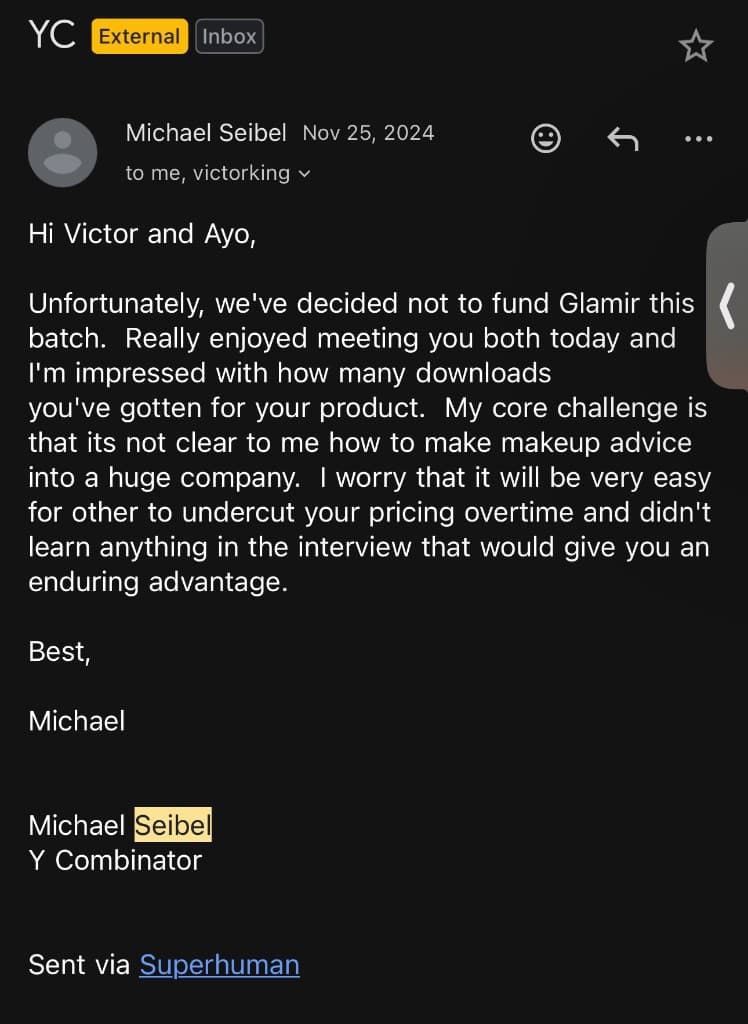
After our interview, Michael Seibel at Y Combinator sent Victor and Ayo a direct note. He said he enjoyed the conversation and was impressed by the download numbers. His core concern was structural: it was not clear to him how makeup advice becomes a huge company, he worried competitors could undercut pricing over time, and he did not hear a durable advantage in the interview.
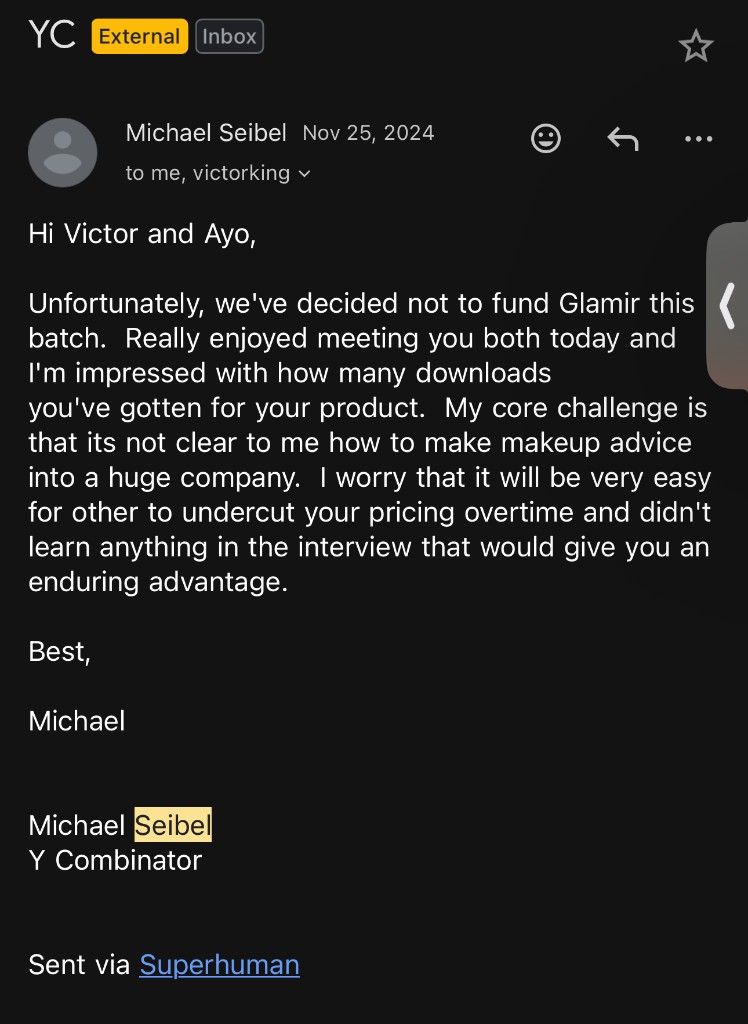
My core challenge is that it is not clear to me how to make makeup advice into a huge company. I worry that it will be very easy for others to undercut your pricing over time and did not learn anything in the interview that would give you an enduring advantage.
That is not a dismissal of the product. It is a company-building critique—and in November 2024, it was accurate. We had validation. We did not yet have a credible path from beauty advice to a platform with hardware, software, and long-term retention.
They were right—at the time
It is tempting to treat investor rejection as a misunderstanding of the vision. Sometimes it is. Here, the gap was simpler: Glamir genuinely was an idea for a beauty tool with three AI features. Users liked it. It could make money. It was not yet obvious how it compounding into something investors would categorize as a venture-scale company.
We did not argue our way past that. We took it seriously. Over the next year we stopped optimizing only for downloads and started building the pieces that turn a prototype into a company: clearer positioning, deeper product surface area, privacy-first hardware, and software we own end to end.
Other conversations along the way
YC was not the only room we sat in. We also spoke with Silicon Valley Bank, Andreessen Horowitz (a16z), and Breakthrough Ventures—each conversation sharpening a different part of the story.
- Silicon Valley Bank — banking and startup infrastructure conversations as we thought about scaling operations responsibly
- Andreessen Horowitz (a16z) — discussions about consumer AI, category creation, and what it takes to build beyond a single viral feature
- Breakthrough Ventures — early-stage feedback on founder-market fit and how we present traction versus long-term vision
None of those threads replaced the work of building. They did force us to articulate why Glamir should exist in five years—not just why it was interesting for five weeks.
What a year of building changed
The Glamir you see today is not the three-feature prototype we pitched in that YC cycle. We kept the education-first app, expanded the product surface, and built toward hardware and software we control: GlamirOS on the Glamir Tri-fold, Glamir Light, and a privacy-first mirror with no camera, speaker, or microphone.
- A clearer company narrative: beauty education, wellness scope, and physical products—not generic makeup advice
- GlamirOS and the Glamir Tri-fold as owned infrastructure, not only mobile features
- Responsible AI principles we document publicly—not just model demos
- Press and community proof points as we grow beyond launch-week spikes
Would we answer Michael's questions differently today? We think so—not because the early traction was fake, but because we spent a year turning traction into strategy.
What we would tell founders in the same spot
- Strong early metrics can get you in the room. They do not automatically get you a yes.
- Listen for the difference between "I do not like this" and "I do not see the company yet."
- If the feedback is right, use the next year to become the company—not to repitch the same prototype louder.
- Investor conversations are useful even when they do not end in a check.
We are grateful for the YC interview, for honest feedback when we only had a prototype, and for the users who showed up in month one. If you are building in beauty tech—or anywhere traction arrives before strategy—we hope this helps.
References
Meet the Glamir Tri-fold
A camera-free smart vanity mirror powered by GlamirOS.
Explore Glamir Tri-fold